|
Mount Etna viewed from a hill in Paterno
|
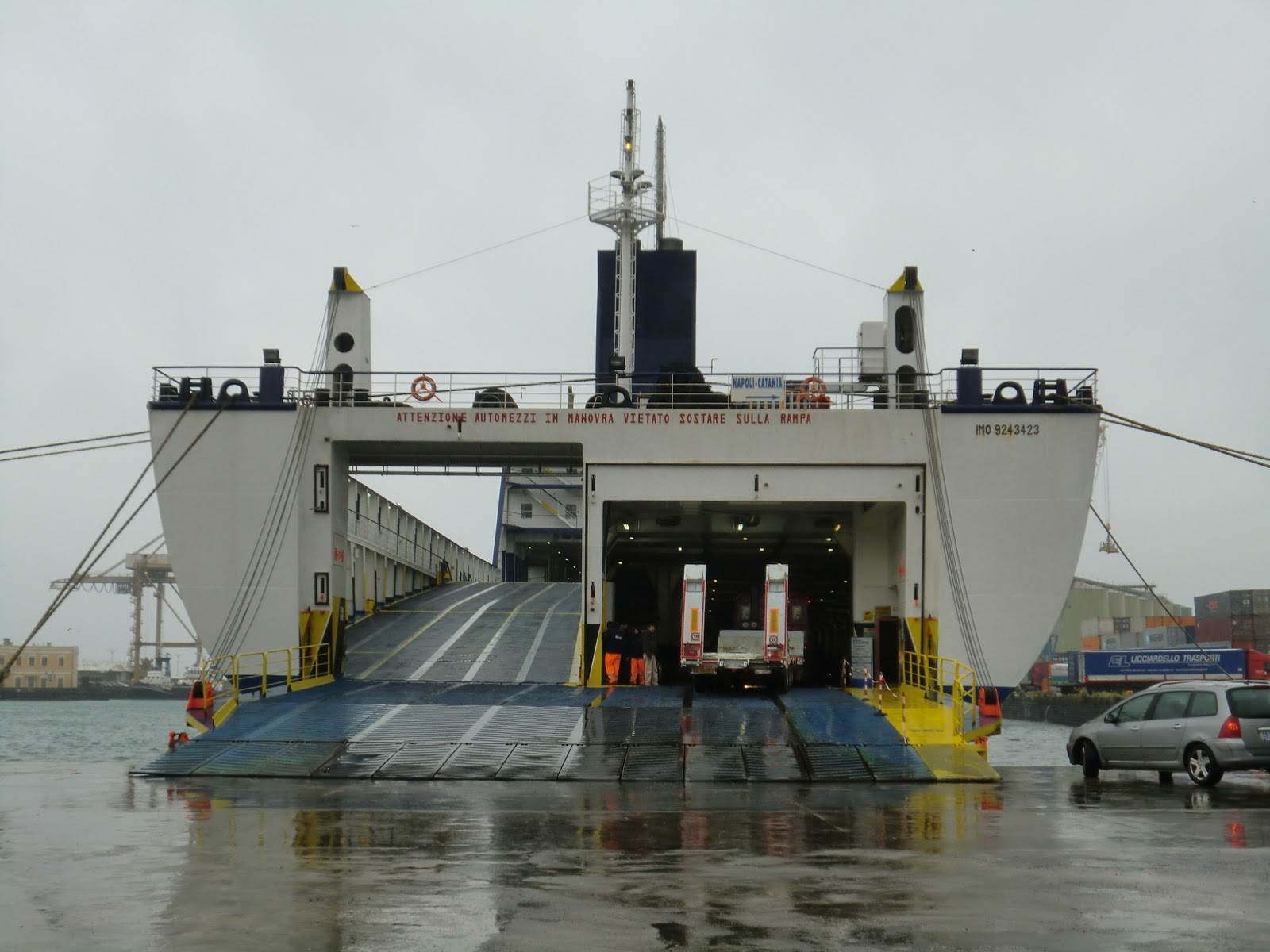
With the beginning of February, it was time for me to return to Sicily to provide orthopaedic coverage for U.S. Naval Hospital Sigonella. Since a month is a long time without a lot of real work to do, it’s nice to have a car to do some sightseeing off of the base. The best way to make that happen is to bring my own car on the overnight ferry from Napoli to Catania. I actually really enjoy the ferry since it is such a relaxing way to travel. Once you get on board, that's it. The most challenging part of the trip is the half hour drive from my Pozzuoli apartment to the Napoli porto. That short drive is good reminder of some of the things I do not like about driving here: no rules (in a bad way) or courtesy among drivers, tons of mopeds and motorcycles coming from every direction, and random pedestrians jumping into the street. The highlight of this most recent trip was when I saw a car about to merge onto the Tange (the equivalent of an interstate that leads to downtown Naples). The driver suddenly changed his mind, threw his car in reverse, and began to back all the way up the entrance ramp (despite the many other cars attempting to merge onto the highway). I do some crazy things in a car over here (things I wouldn’t dream of doing at home), but this was a pretty bold move by the dude. He must have really wanted to avoid paying the 0.85 Euro toll to turn around the right way. But then, maybe he was doing it the “right” way. Unfortunately, the fun isn’t over once you arrive at the port. In all the mass of cars and tractor trailers trying to get on the ferry, you have to fight your way to get near the ticket office, park illegally, run inside to wait in line to get your actual ticket, and then jump back in the line of cars waiting to board the ferry. Fortunately, I had really wanted to avoid this, so I arrived very early. As one of the first to board, it was a fairly painless experience.


After first driving up the ramp to get on board and then down the next ramp to park in the garage, you proceed upstairs to the check in desk to get the keys to your cabin - just like in a hotel. (You don’t have to get a room, but it really is well worth the price. “Sleeping” in one of the chairs in the open lobby area would be pretty awful, but many people do it.) I recognized the lady at the front desk from my previous trip down to Sicily this past September. She took one look at me and said, “You are going to Sigonella.” Definitely a statement and not a question, and testimony to how much Americans stand out from the locals. (This exact same thing had happened with her in September, so I wasn’t shocked.) She then made a fist, tapped it on her forehead, and said something about me having it “stamped” on my head. Before giving me the key to my cabin, she said, “You were here before. With your mom and dad.” Sure enough, she was right, they were with me last time. I was impressed, she was smart. And I apparently do not blend in.
 |
| For what it's worth, I don't mind not blending in. Especially with that guy. |
The ferry ride itself is great. It leaves Naples at 9PM and arrives in Catania at 9AM. Occasionally, it gets a little rough with the waves, but mostly it is a calm, gentle rolling. After grabbing dinner from the buffet line, I settled into my room, fired up my laptop with my buddy’s Sopranos DVDs, and got a great night’s sleep.
The ferry arrived in Catania as scheduled the next morning. After showering, I went out to walk around the deck for a bit as I had some time to kill before they let the passenger cars unload. It was raining fairly hard, but it was interesting to see the anchor lowered and the ferry tied up. After the passengers without cars and the trucks had been unloaded, it was finally time to head downstairs to the deck where mine and the other passenger cars were parked. After driving off the ferry, it was only a twenty minute drive from the Catania port to the base.
 |
| Arriving in Catania. |
 |
| Anyone have a cigarette? |
 |
| Catania |
Since arriving, it has been pretty relaxing. NAVHOSP NAPLES isn’t exactly a busy place, but NAVHOSP SIGONELLA makes it look like a level 1 trauma center (well, that may be a bit of an exaggeration…). I see clinic twice a week and remain available for whatever emergencies come up (though the hospital doesn't have the capabilities to handle anything too serious). My previous month here in the fall, I only made it to the OR once for an elective knee arthroscopy. Amazingly, the first week this time around, I made it to the OR twice – to fix two finger fractures, one of them an open fracture. So at least that was interesting and I felt like I was actually contributing. Hopefully, things will keep up in the coming weeks to make work more exciting and rewarding.
Though work is slow, I really have been given the gift of time and I have been trying to make the most of it. I enjoy working out in the gym every day, running through the orange groves outside of the base, reading orthopaedic journals, reading history books, using Rosetta Stone to work on my Italian, and doing some sightseeing.
 |
| Mount Etna - a ten thousand foot high active volcano that dominates the landscape of the eastern side of the island. |
Sicily is a triangular island in the Mediterranean that is approximately the size of Vermont. It is certainly a beautiful and interesting place with an amazing history, particularly because it has been conquered by just about everyone over the centuries – Greeks, Romans, Vandals, Ostrogoths, Byzantines, Normans, Spaniards, Bourbons, and, most recently, the Americans and British in World War II. According to Henry Adams, "Sicily in all ages seems to have taught only catastrophe and violence ... For a lesson in anarchy ... Sicily stands alone and defies evolution."
 |
| Cemetery in Paterno |
 |
The Ionian Sea from Acireale
Norman Castle in Paterno |
The highlight of my first weekend was making it to downtown Catania to see the Saint Agata Festival. Saint Agata was martyred in Catania in 251 A.D. and is the city’s patron saint. The festival is one of the world’s largest celebrations for a saint and it is a HUGE deal here (and has been since the first festival in 1519). The relics of Saint Agata (bones from her legs, arms, skull, etc,) are contained in crystal and silver caskets and inside a bust of her head. These are then are carried throughout the city in the “Vara” - a 16 foot long richly decorated silver carriage. Apparently, the golden crown is studded with gems donated by King Richard “The Lionhearted” in 1190 during his visit to Sicily on his way to a crusade.


I was fortunate to make it into town for the second night of the three day festival. The streets were jam packed, but I managed to make it into the Church of Saint Agata just as a Mass was ending and the carriage was being prepared to be pulled through the streets of Catania. It was interesting to see the devotion of the Catanians honoring Saint Agata. I guess they should be devoted, considering that on two occasions she has been credited with preventing eruptions of Mount Etna from destroying the city. In both instances (251 and 1886), her veil was brought in procession to the eruption site and the advancing lava flow miraculously stopped.


After the carriage was rolled out of the church doors, it stopped in the small piazza out front, was loaded with more candles, and the long rope to be used to pull it through the streets was uncoiled and passed forward to the many devotees entrusted with pulling the carriage. The carriage then began moving forward and the crowd slowly parted before it.
It slowly advanced though the streets before stopping at a larger intersection for a large fireworks show. I have to say that fireworks are another thing that Italians do very well. This show was close, loud, and long. The streets were filled with smoke, smelled of gunpowder, and paper debris from the explosions rained onto the crowd below. It seemed that the party was just getting going (they pull the carriage around for hours), but for me it was well after midnight and my evening was ending. But it was definitely one of the more interesting experiences I’ve had over here.


 After looking around a bit, I sat down amongst the rest of the tourists in one of the center pews. For about twenty minutes, I relaxed and read my guidebook describing the church. As I sat there reading, reflecting, and praying; two men walked to the front of the pews and began addressing the crowd. One of them was clearly an American priest (Roman collar and speaking English with a Boston accent) and he began describing the history of the church and its artwork. As I sat listening to him, I began to look around at the people sitting in the pews near me. I was surprised to finally notice that I was completely surrounded by about thirty middle-aged men, who were also clearly American priests. As the priest in front continued speaking, he remarked that the next part of their tour would be the Camere of St. Ignatius. I had read about these rooms before – they were in a building just adjacent to the church and were where St. Ignatius had lived, worked, and died. I was excited at the possibility of getting to see these rooms.


 Adjacent to the reception room was a chapel used by St. Ignatius and his fellow Jesuits. Its simplicity was in stark contrast to the neighboring Gesù Church (and it certainly reminded me of other similar chapels from my school days - specifically, Morrissey Manor’s Chapel and Georgetown’s Copley Crypt). The next thing I knew, all of the priests began filing into another back room. Not sure what I had missed (as I had been paying attention), I peered in to see that they were donning vestments in preparation for celebrating Mass in the chapel. Not wanting to intrude any more than I already was, I just hovered in the back corner of the chapel and tried to stay out of the way. However, one of the priests then came up to me and introduced himself. He, along with the others, was obviously very excited for the opportunity to celebrate Mass in this special chapel. He pressed his small digital camera into my hand and asked that I subtly take a few pictures of him during the Mass (at appropriate times, of course).


 After looking around a bit, I sat down amongst the rest of the tourists in one of the center pews. For about twenty minutes, I relaxed and read my guidebook describing the church. As I sat there reading, reflecting, and praying; two men walked to the front of the pews and began addressing the crowd. One of them was clearly an American priest (Roman collar and speaking English with a Boston accent) and he began describing the history of the church and its artwork. As I sat listening to him, I began to look around at the people sitting in the pews near me. I was surprised to finally notice that I was completely surrounded by about thirty middle-aged men, who were also clearly American priests. As the priest in front continued speaking, he remarked that the next part of their tour would be the Camere of St. Ignatius. I had read about these rooms before – they were in a building just adjacent to the church and were where St. Ignatius had lived, worked, and died. I was excited at the possibility of getting to see these rooms.


 Adjacent to the reception room was a chapel used by St. Ignatius and his fellow Jesuits. Its simplicity was in stark contrast to the neighboring Gesù Church (and it certainly reminded me of other similar chapels from my school days - specifically, Morrissey Manor’s Chapel and Georgetown’s Copley Crypt). The next thing I knew, all of the priests began filing into another back room. Not sure what I had missed (as I had been paying attention), I peered in to see that they were donning vestments in preparation for celebrating Mass in the chapel. Not wanting to intrude any more than I already was, I just hovered in the back corner of the chapel and tried to stay out of the way. However, one of the priests then came up to me and introduced himself. He, along with the others, was obviously very excited for the opportunity to celebrate Mass in this special chapel. He pressed his small digital camera into my hand and asked that I subtly take a few pictures of him during the Mass (at appropriate times, of course).